

SCARPA Sizing
A comfortable pair of footwear is one of the most important parts of enjoying your time outdoors. When your walking boots or shoes fit correctly, there’s far less chance of painful pressure points and blisters — and you’ll get the best performance from your SCARPA footwear.
The information below will help you choose the right SCARPA size and fit, and maximise your enjoyment in the hills and on the trails.
Boot & Shoe Fitting FAQ
How Do Find the right boots and size
Start with length, then confirm toe room. A quick at-home check:
- Download our handy foot measure tool (Click to download)
- Stand on it with your heel right to the back
- You should have around a finger width of space in front of your longest toe
Most SCARPA UK footwear is sized primarily in EU sizes. Use the conversion guidance on each product page to choose your best match.
It comes down to two things:
- Length (your size)
- Shape/volume (the last and the model design)
Even in the same size, different SCARPA models can feel different because they’re built for different activities and fits.
Yes — but only try footwear on indoors. We advise that items worn outside can’t be returned.
We also offer free returns within 60 days of purchase.
A last is the foot-shaped mould a boot or shoe is built around. It determines the overall fit, including:
- toe shape
- width and volume through the midfoot
- heel shape and hold
SCARPA develops different lasts to suit different end uses, so two models can fit differently in the same size.
SCARPA was the first company to develop a purpose-made last for women’s boots. Many women’s-specific models use a dedicated female last, which is typically slimmer through the midfoot and heel.
Good to know:
- A slim, low-volume male foot can sometimes suit a women’s last.
- A higher-volume, broader female foot may be better suited to the standard/male last.
Try boots and shoes on in the evening, when your feet are naturally at their largest.
Wear the socks you’ll actually use.
SCARPA recommends avoiding cotton and choosing proper walking or running socks that manage moisture and reduce friction.
You’re aiming for:
- secure heel hold (minimal lift)
- supported midfoot (snug, not crushed)
- toe room (toes can wiggle; no pressure at the front)
- no rubbing or pinch points anywhere
If it’s uncomfortable indoors, it won’t improve outdoors.
That’s usually a shape/volume mismatch rather than a length issue.
Take the footbed out, stand on it and double check the size. If it looks right but you’re getting pressure points, heel slip or toe contact, you can adjust the volume by using thicker insoles or volume reducers. Don't force it with thicker socks.
If this doesn't help the often switching to a different SCARPA model/last will help.
Approach Shoes
Approach shoes are designed for precision and stability on technical ground, so they often fit snugger than walking shoes, especially through the midfoot.
You’re aiming for:
- secure heel hold
- snug, supported midfoot
- toes not touching the front on descents
- no hotspots at the sides or over the top of the foot
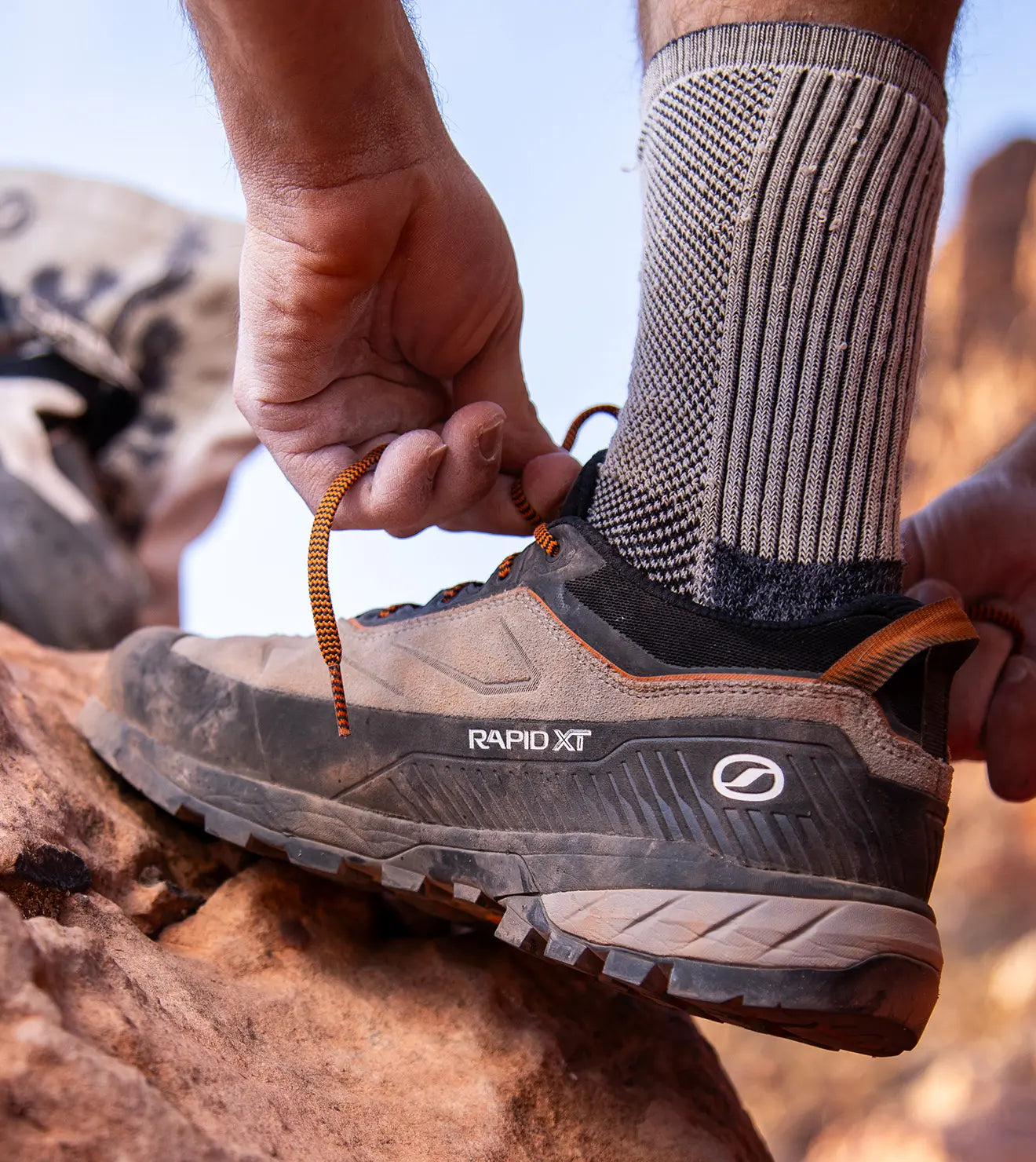
UK approach models currently include options like Crux, Mescalito GTX, and the Rapid family (including Rapid XT, Rapid LT, and GTX / Mid GTX variants).
Trail Running Shoes
Trail running shoes should feel secure and controlled, with enough toe room for natural swelling and longer descents.
You’re aiming for:
- locked-in heel (no slipping when climbing or cornering)
- secure midfoot
- wiggle room at the toes
- no rubbing at the little-toe joint or arch
SCARPA trail running models currently include the Ribelle family, our soft ground specialist Spin ST, Spin Ultra 2, and our door-to-trail certified Golden Gate LT (plus women’s versions where applicable).
SCARPA UK groups trail running shoes into Short Distance, Medium Distance, and Long Distance to help you choose based on your typical run length and needs.
A simple guide:
- Short distance: maximum agility and responsiveness
- Medium distance: balanced cushioning + control
- Long distance: comfort and protection for more time on feet
SCARPA Climbing Shoe Chooser
Many climbers do size climbing shoes differently to street shoes, because climbing shoes work best with minimal gaps. However, there isn’t one universal rule — it depends on:
- the model (last, volume, downturn)
- your foot shape (width, volume, toe profile)
- how you’ll use them (indoor, bouldering, sport, trad)
- your comfort vs performance preference
Best approach: start from your measured size and choose one of the categories below.
Ask yourself this question:
How long do you want to keep your climbing shoes on at a time?
- Mostly all session / all day → Relaxed Fit
- On and off through a session → Precision
- Short, hard tries (steep boulders / hard sport) → Specialised Performance
Relaxed Fit
Choose Relaxed Fit if you want:
- comfort-first fit for longer sessions and extended wear
- a more forgiving feel in volume and shape
- an ideal starting point for beginners, coaching, or trad/multipitch days
Precision
Choose Precision if you want:
- a snug, accurate fit for confident foot placements
- a balanced blend of comfort and performance
- a great “do-it-all” option for indoor climbing, bouldering, and sport climbning
Specialised Performance
Choose Specialised Performance if you want:
- maximum performance for steep climbing, bouldering, and hard sport
- the most dialled, locked-in feel for power and precision
- shoes that are best used in shorter bursts rather than worn all day
Try these in a safe indoor setting:
- Heel test: stand on tiptoes or pull gently on a door frame—heel should stay seated with minimal lift.
- Toe test: you shouldn’t feel your toes sliding forward into empty space; they should feel supported.
- Dead-space test: pinch the upper—there shouldn’t be significant loose material anywhere.
Most climbers wear climbing shoes without socks for fit and sensitivity. If you do wear socks (often indoors for comfort/hygiene), use very thin socks and expect the fit to feel different.
Comfort / all-day fit (beginners, trad, long sessions):
- toes feel snug but not aggressively crimped
- you can keep them on for longer periods
- great for learning footwork and building confidence
Performance fit (bouldering, steep sport, precision edging):
- noticeably tighter, more “locked in”
- more precision and sensitivity
- usually worn for shorter bursts rather than all day
They should feel tight, but they shouldn’t be unbearable. If they’re so painful you constantly need to take them off, you’ll climb worse (and wear them less). Aim for “snug and controlled” rather than “agonising.”
Climbing shoes are designed to fit much closer than walking footwear. The goal is a snug, precise fit with no baggy areas, so your foot and shoe work as one.
A good fit should feel:
- very snug all over (especially through the heel and midfoot)
- no dead space (you shouldn’t be able to pinch loose material)
- secure heel (no sliding when you step or pull with your toes)
- toes supported (not floating), with the amount of toe “curl” depending on the shoe type and your goals