
The Apocalypse 50 Ultra Marathon by Carmine de Grandis
9 May 2026 — 50 miles, 3100m, Shropshire Hills
More than 10 years ago, I first explored the Shropshire Hills thanks to a new race created by Beyond Marathon: the Apocalypse 50. An ultramarathon like no other, with enough distance and elevation gain — and loss — to test the brave… or perhaps the “stupid”, like me. I took part in the race in 2014 and 2015. Back then there was also a 100-mile option, although I was never brave enough to attempt it.
After a few years away, Beyond Marathon relaunched the race with a twist: four different loops with very different elevation profiles and distances — Famine, Conquest, War and Death. You get the idea. Harder than its predecessor, with more elevation and more challenging terrain, what truly makes this race unique is the level of strategy and mental strength it demands. Competitors can run the four loops in any order and in any direction. It is impossible to know who is leading until the winner crosses the line.
Adding to the challenge is “The Only Checkpoint” in Church Stretton. The checkpoint is warm and welcoming, with constant access to food and drink, plus your kit bag waiting with everything you need before heading out again. The perverse twist is that the checkpoint is almost designed to make you waste time and question whether you really want to head back out onto another brutal loop. I should also mention that every runner can stop after any number of loops and still receive a medal for 1, 2, 3 or 4 loops completed. Everyone is a winner… or maybe not.
This year, my running and racing have been challenging. A health issue in early January stopped me from competing until April. I had to record two DNS results in races I had entered and genuinely wanted to run — something almost unheard of for me. By April, training had started to improve again, and I decided to combine adventure, solo challenges and this race. I called Richard, the Race Director, and asked if there was any chance I could return to the Apocalypse 50. Thankfully, he said yes.

Like most ultra runners, I do not have the luxury of being a professional athlete. I work for a living and fit training around family and other commitments. April and May quickly filled up with travel and long working hours. I managed to squeeze in a holiday week hiking the South West Coast Path around North Cornwall and Devon — amazing scenery and excellent training. Then I headed to the Lake District to work for Scarpa. While there, I took a day to run the George Fisher Tea Round with my dog Norman. That broke me… but I am glad I did it.
A few days later, I decided to test my fitness at a local parkrun to establish a baseline for the next block of training. Encouragingly, there was still a bit of speed left in the legs of an old man.
The real unknown was the ultra itself. What would my strategy be? What should my objectives look like? I had not raced 50 miles since the Spine Race Challenger North. Yes, I had run the Dragon's Back Race, but even the longest day there is shorter than 50 miles. Another unknown was the need to run consistently due to the rolling nature of the Apocalypse course.
I decided my aim was to compete. My objectives became either a podium finish — unlikely — or perhaps a top-10 result, which felt more realistic. Recently I have been training to become more competitive within my age category, and the only way to improve is to turn up to races and truly race them, rather than simply enjoying the run, the community and the landscape.
In truth, the idea of competing still scares me. I naturally want to enjoy myself and talk to people while running. What if I pushed hard and still failed to meet my expectations? Doubts filled my mind, and for good reason. Yet I also wanted to see what I was capable of, and I could not ignore that voice in my head.
The week before the race, my legs still felt heavy from the previous training load. I decided to fully rest the day before and carefully prepare my kit and nutrition. When racing, every detail matters: shoes, pack, clothing, GPX files, food, hydration, whether to go light or heavy, weather forecasts, analysing previous years’ results… the list goes on.
I woke at 5am overlooking the beautiful Carding Mill Valley. Jenny drove me to the start. I saw Richard and many familiar faces, and before long we were underway on a glorious t-shirt-weather kind of day.
Originally, I planned to start with the Famine loop, the longest of the four. However, being around large groups of runners tends to affect my race plan and mindset, so I pivoted and chose the hilly Conquest loop instead. Before long I was running alone, taking in the views while monitoring pace and effort. I loved this loop, especially the cloud inversion at the top of Willstone Hill. I returned in under two hours — quicker than expected and broadly on track for a 9–10 hour finish.
I quickly refilled my soft flask with Voom nutrition fuel and headed straight out onto the Famine loop. Running across the Long Mynd felt special. Normally I dislike running on country roads, but I found myself enjoying the quiet lanes and long descents. My goal was not to settle into a plod. I aimed to keep my effort around Zone 2, staying just below threshold for as long as possible. I also managed to eat every 20 minutes. The strategy was working.
I occasionally crossed paths with other runners, mostly heading in the opposite direction. Encouraging them as we passed gave me energy and joy. I completed the loop faster than expected, although a small fear crept in: would I be able to hold things together through the final two loops? Would there still be any bounce left in my legs? No time for doubts.
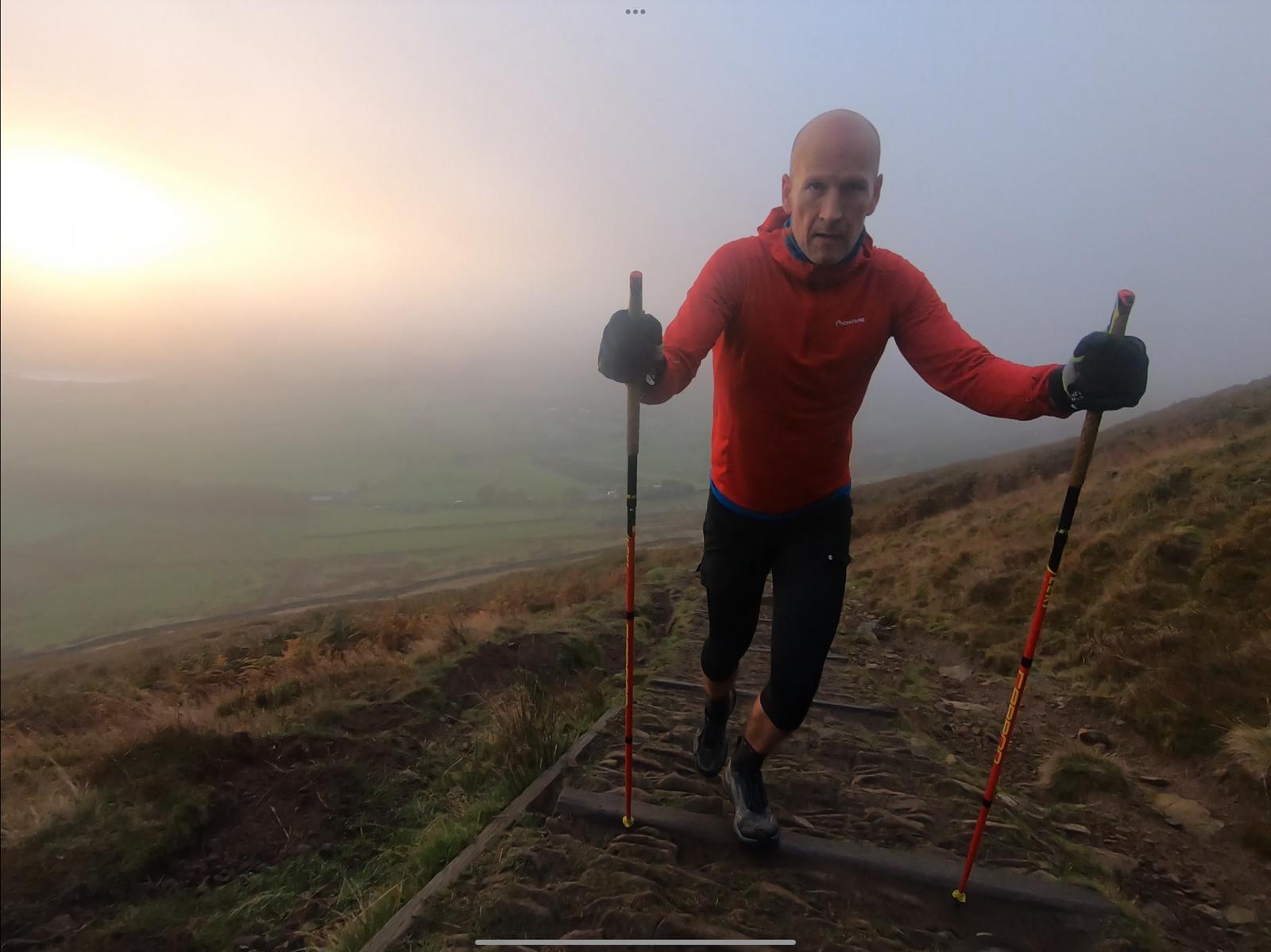
Back at the checkpoint, I still had no clue who was ahead or where I stood overall. I decided to tackle the War loop anticlockwise: a long route with difficult sections but also plenty of runnable terrain. I was pushing hard. The poles helped on the climbs, and seeing runners coming toward me — most people run the loop clockwise — kept me motivated.
To have any chance of a sub-10-hour finish, I needed to complete the loop inside seven hours overall. Fatigue was building, though, and eating had become more like force-feeding a baby. After one particularly steep and technical descent, I realised I had invested too much to give up on my goals. I told myself this was the moment to dig deep.
Back at the checkpoint, I briefly considered changing socks. In the end, I decided I was not uncomfortable enough to justify losing time, especially with only the final 10-mile loop — Death — remaining.
I headed out anticlockwise again, preferring steep descents over long climbs. The climbs were still savage, but there were plenty of runnable rolling trails in between before more steep hills arrived. At one point I watched gliders soaring overhead — beautiful and mesmerising. I ignored the fatigue and kept moving.
I met more runners on this loop, many encouraging me to keep pushing. Everyone was so kind and supportive. I felt humbled and grateful. I hope I gave something back to everyone I met too.
One highlight was seeing my wife out on the course. She had been tracking me and came out to cheer me on. I also kept checking the elevation profile on my watch. There was still more climbing before the final descent.
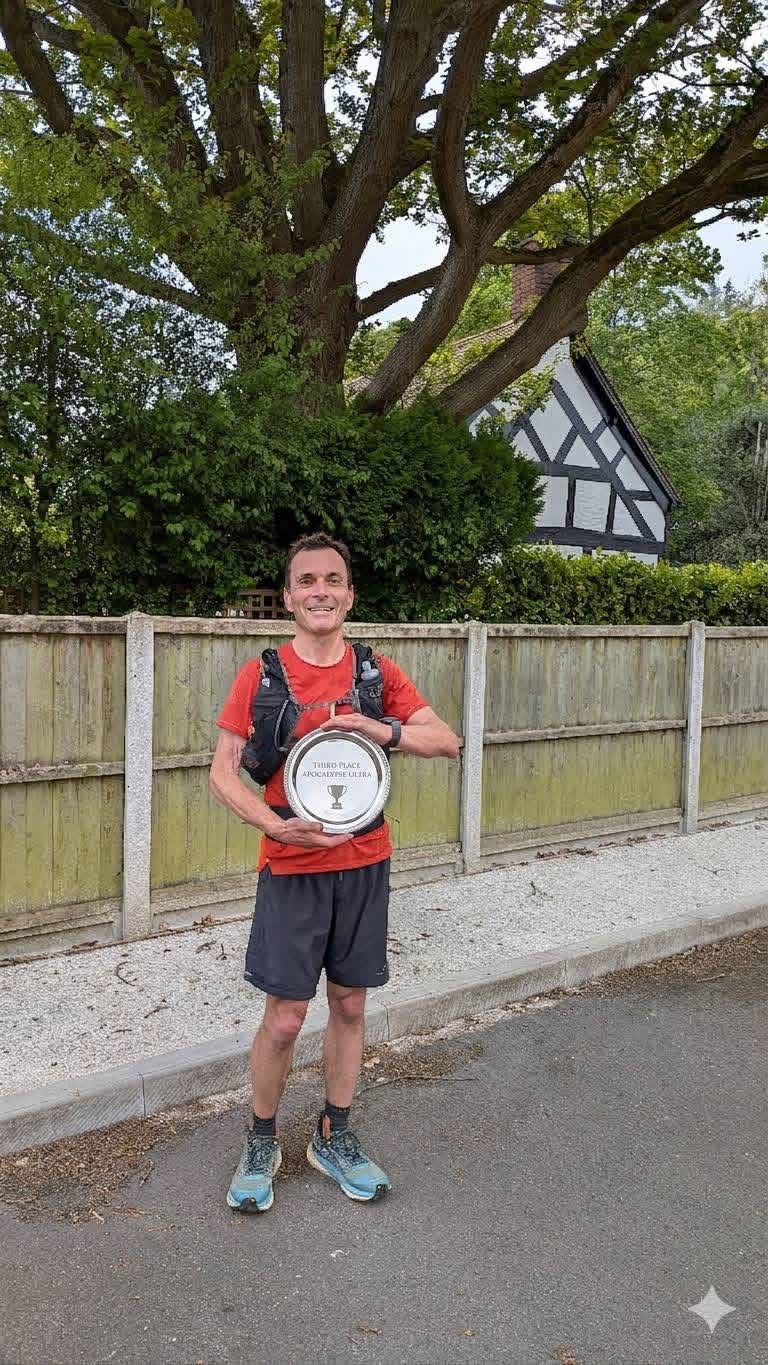
Eventually I saw Church Stretton below me. I realised my dream of going sub-10 hours was slipping away. The course ended up being closer to 52 miles… although that is no excuse. I crossed the line in 10 hours and 9 minutes, finishing 3rd overall.
It felt incredible to achieve my goal.

Everyone around me was brilliant. Some runners were preparing to head back out for another loop, while others were celebrating their own achievements before heading home. Jenny found me at the finish and looked after me while I slowly got myself together.
To fully put this race into context, I could write much more. But my biggest takeaway is this: over time, we can continue to improve, and age really is just a number. I ran this race faster than I did 10 years ago when I was pushing incredibly hard… with the added bonus that this time I could actually walk properly afterwards. Maybe I did not run hard enough after all. How do we find those extra marginal gains?
As always, I run with in mind those who cannot longer run — especially people suffering with cancer. As the founder of Climbers Against Cancer always said: “In life we are all climbers.” We should always carry those we love in our hearts during our adventures.
I am also incredibly grateful for all the lovely messages I have received from friends who follow my running journey on Instagram at @outdoorspirit1 and @mountainaccordionman, as well as across other social media platforms.
I run for fun, for physical and mental health, but above all for spiritual awareness.
La vita è bella!
Carmine